 |
| Photo by Robert Catto |
Ca Va Productions presents, IN THIS LIGHT, by Noel Hodda, at the Flight Path Theatre, Addison Road, Marrickville, November 1st - November 19th.
IN THIS LIGHT, is a new Australian play by actor, Noel Hodda. This play has been "around the traps" as they say, for several years and at last arrives for audiences in the Flight Path Theatre, at Addison Rd Community Precinct, in Marrickville.
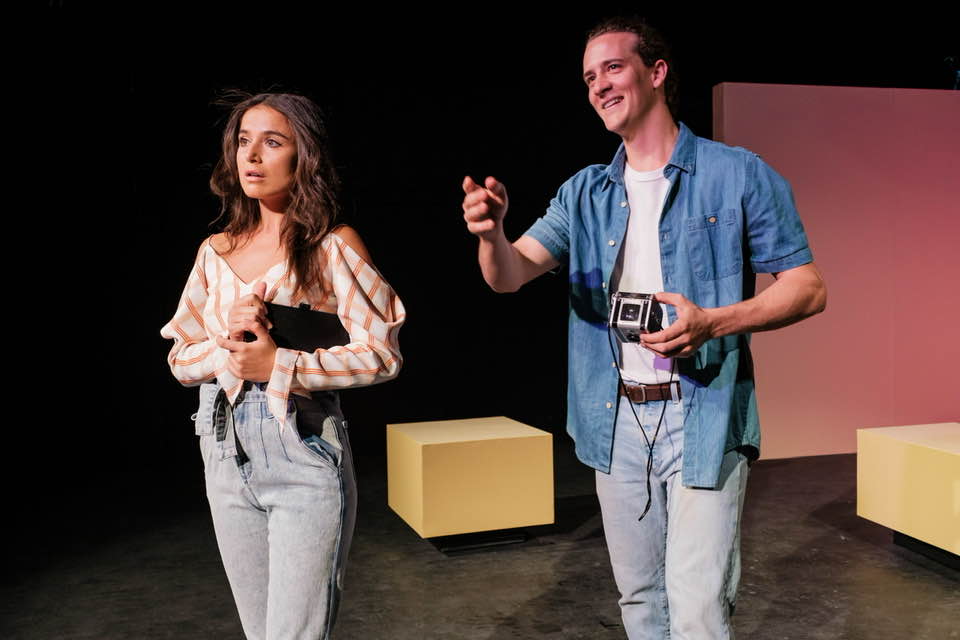
The play is in two acts, set in Paris, France and Canberra, Australia, late in the last century (there is no such thing as the internet or iPhone!) In the first act a very young Peter (Tom Cossettini), decides to leave country Queensland and travel, backpack, his way across Europe. We meet him in Paris at the Louvre Museum, in front of a Van Gogh art work, with a family camera heirloom in one hand whilst searching for the Mona Lisa. He crosses paths with a young Parisian, Camille (Omray Kupeli), and with a dated French phrase word book in the other hand, begins a whirlwind acquaintance. It is most amusing, awkward and yet, attractive.
Meanwhile, in Canberra brother Chris (David Adam), a parliamentary assistant, and his sister composer Sandra (Sophie Gregg), in a moment of shared grief make a pact with a handshake promising to care for each other to the end, even to euthanasia, if necessary.
One couple falls in love. The other pair is shattered when one has a severe medical occurrence and is hospitalised.
Time passes. Years pass.
In the second act, Peter, now an older reclusive sculptor, in country Queensland, is visited (invaded) by a young French woman, Clare. Clare arrives unannounced with photographs and an old camera and with much opposition and misgivings from Peter unpacks a possible history that could connect these two strangers intimately. For, Clare is, possibly, Peter's daughter - a being of whom he had had no idea of her existence.
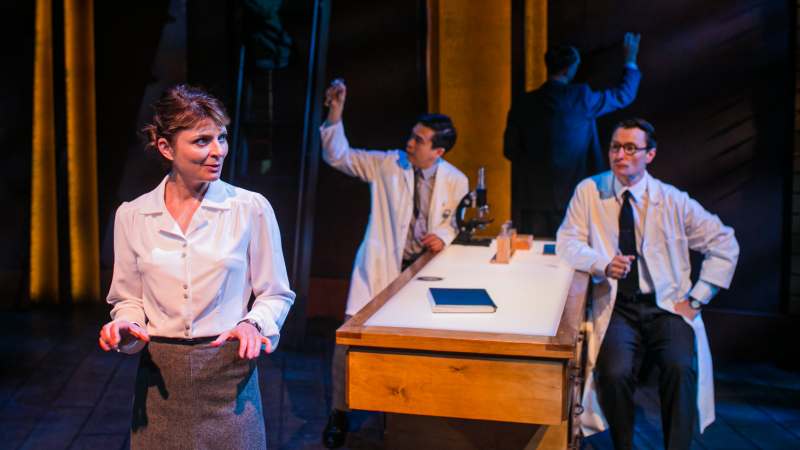
Whilst in Canberra, Sophie has watched her brother deteriorate into such a state that she feels obliged to honour a long past handshake promise and with conflicting states of mind euthanises him. Chris's nurse (Kate Bookallil) is placed in a dilemma that forces a confrontation with her sense of duty and her personal compassion for what Sophie has done.
Two continents, seven lives and twenty years meld into one transforming experience. IN THIS LIGHT, is a celebration of love, loss and reconciliation.
The first act of this play is constructed with the usage of many, many short scenes and, unfortunately, the Director, Des James, has unimaginatively decided that these scenes will be created by the exit and entry into light spotted areas. The Scenes can have dialogue or, on occasion, otherwise, simply visual statements of the character's journey. Mr James's direction requires the actors, even the actor playing the incapacitated Chris to walk onto the stage, lay down on a bench and cover himself with a light rug, to then have to stand and walk off into the wings of the space when the scene location changes.
My memory, and my companion's memory of the first act, is one of a bewildering, clattering 'dance' of entry and exit with the actors accompanied by a flurry of Sound (Jeremy Ghali) and the raising and fading of Lighting states (Grant Fraser), that reveal a pragmatic set of 'shapes' that may signify a bed, chair or table (Designer, Angelina Meany), with which the actor then must establish character, space identity, and the emotional state of the character with the responsibility of telling the story. That is, to tell us who they are, where they are, when it is (both the literal and, more importantly, the emotional when), in the arc of the journey of each of the characters, to reveal: what they want, why they want it and how they get it (the six basic Stanislavski questions that elucidate for the audience what is happening).
In Shakespeare's play, Hamlet in his instructions to the actors whom he has employed to present the play, THE MOUSETRAP, to help him decide what he should do concerning his Uncle, the new King, Claudius, at the Ghost, his father's bequest, says "Let the words suit the action and the action suit the word" so that the playing by the actors has maximum clarity. Mr James with his decision for the actors to enter and exit for every scene, in the first act, perforce, creates too much physical action for the audience to be able to read comfortably what he has given them to see, and inhibits their ability to believe what they are seeing, as it has become muffled, even sometimes, opaque. Alternately, having the actors always present in their place on the stage with just the rise and fade of the lighting the dramaturgical demands that the writer, Mr Hodda, has made for his storytelling needs could be clearer - the text in this act seemed to be more a screenplay than a theatre play. The first act was bewildering.
In contrast, the second act had longer concentrated scenes of dialogue and dramatic development and therefore was more fluid in its storytelling reveals and, on the whole, was much more available to our having a comfortable and enlightening 'read' of the complexities of the characters. The play became a much more interesting experience because there was less physical action, less entering and exiting, less 'noise' to distract us from the intentions of the writer. For, there is an interesting experiment of form that Mr Hodda in the construction of his play is investigating : the games of the usage of TIME, as the two stories in each act are intertwined over the actual twenty years that the characters live through.
The company of actors are uniform in their ability and have a committed and shared energy to the characters, the narrative and the stylistic demands that the playwright offers and the director demands.
Di Smith, the co-producer of this production, in a prologue before the audience entered the theatre, reminded us of the sacrifices all of the artists presenting this work have made - no one is paid - it is all a labour of love to present an Australian play that speaks with a national resonance, a national mirror for us to read, to see and take lessons from. Watching IN THIS LIGHT was another indication of the Cultural Leadership that is made in this city by the industry at large, the unemployed, the underemployed. Recently a community based theatre company: Endangered Productions presented a production of Ibsen's PEER GYNT with a cast of 90 performers onstage, including an orchestra of 30 musicians. Believe it or not, at the Paddington RSL Club! It was a moving experience. Not just for the impact of the greatness of the text of the play PEER GYNT, translated by Australian May-Britt Ackerholt, but, also, for the commitment of all those artists, doing it for NOTHING. Only 4 performances but all sold out with many luminaries of the
industry in the audience attending this premiere season. It was the first time in Australia where the play by Ibsen and the score by Greig was played live, together. An extraordinary achievement.
Ms Smith pointed out, this company, CA VA, has six actors on stage, unlike the major professional company of this state: The Sydney Theatre Company (STC) - funded by our State and Federal Governments - who have more often than not, only one actor or two or three on stage (thereby, perhaps, signalling to the acting profession in this city - that has suffered untold loss of opportunity because of the pandemic demands and restrictions - that they are dispensable). It seems the STC is a Director's and Designer's theatre - for and by Auteurs. The writer and the actor are subject to manipulation by these two other elements (even employing film techniques - Cine-theatre, the Artistic Director of the STC, Kip Williams, has styled it in a recent 'magazine' feature - to edit out some of the actor's offers). I've always believed the Writer is God and the Actor the Sacrifice supported for clarity in the storytelling by the Director and the Designer.
By the bye, I have often wondered at the size and budget cost of the administration of the STC, its staff, and of the expense of the Design and Lighting elements of the recent STC Productions (just the cost of the electrical bill - of the carbon foot-print - for a single performance of the much lauded THE PICTURE OF DORIAN GRAY, for example, or STRANGE CASE OF DR JEKYLL AND MR HYDE), that can then only employ ONE or TWO actors. (Actors that, contractually, are employed per production - with no holiday pay or holiday benefits etc. in contrast to the administrative and artistic permanent staff?) There does not appear to be a sense of Cultural Leadership emanating from the STC Administration or, importantly, from the STC BOARD Members, towards the acting profession. Less set Design and more actors on stage, please. I mean, 3 actors serving Shakespeare's JULIUS CAESAR. Really? In a city with a large pool of actors available. Even if you were paying Equity minimum there are actors galore, available, waiting to explore their skills in the service of the audience in Sydney to join together to tell Shakespeare's JULIUS CAESAR. How embarrassing it is to see the National Theatre Broadcasts at the Dendy Cinema and see 20-30 actors taking a curtain call compared to our 1 or 3 or 6 or perhaps 10! on the STC stage.
On opening nights, the STC having stacked the house with free tickets, I often wonder how many actors are invited as compared to how many administrative staff or the Influencers on the Internet, dressed to the nines and not really concerned with the Art of the Theatre at all - the stand-up and applaud every production at the STC (as if it was a cultural requirement), like the 19th Century 'bribed' theatre claques, no matter the actual quality of the performance? It drives me CRAZY. I'm, also, certain those actors sitting in the theatre with the free ticket, generously given by the STC Administration, would much prefer to be on the stage.
Therefore, I recommend a night at the modest Flight Path Theatre in Marrickville, to see the modest but determined production of a new Australian play by one of Sydney's striving artists, Noel Hodda. Take a friend and thank, by your support, the artists of Sydney, attempting through self sacrifice, to give you a broader experience in the theatre than the, generally, moribund work that the STC gives.
"IN THIS LIGHT, EVERYTHING IS POSSIBLE."